A Silent Threat to Nigerian Businesses
For many Nigerian SMEs, fines from the Federal Inland Revenue Service (FIRS) don’t come as a result of fraud or deliberate tax evasion. They come quietly through missed deadlines, incomplete filings, poor record-keeping, or a misunderstanding of tax obligations. Unfortunately, when these mistakes catch up with a business, the financial consequences can be severe. Avoiding FIR penalties can be very simple.
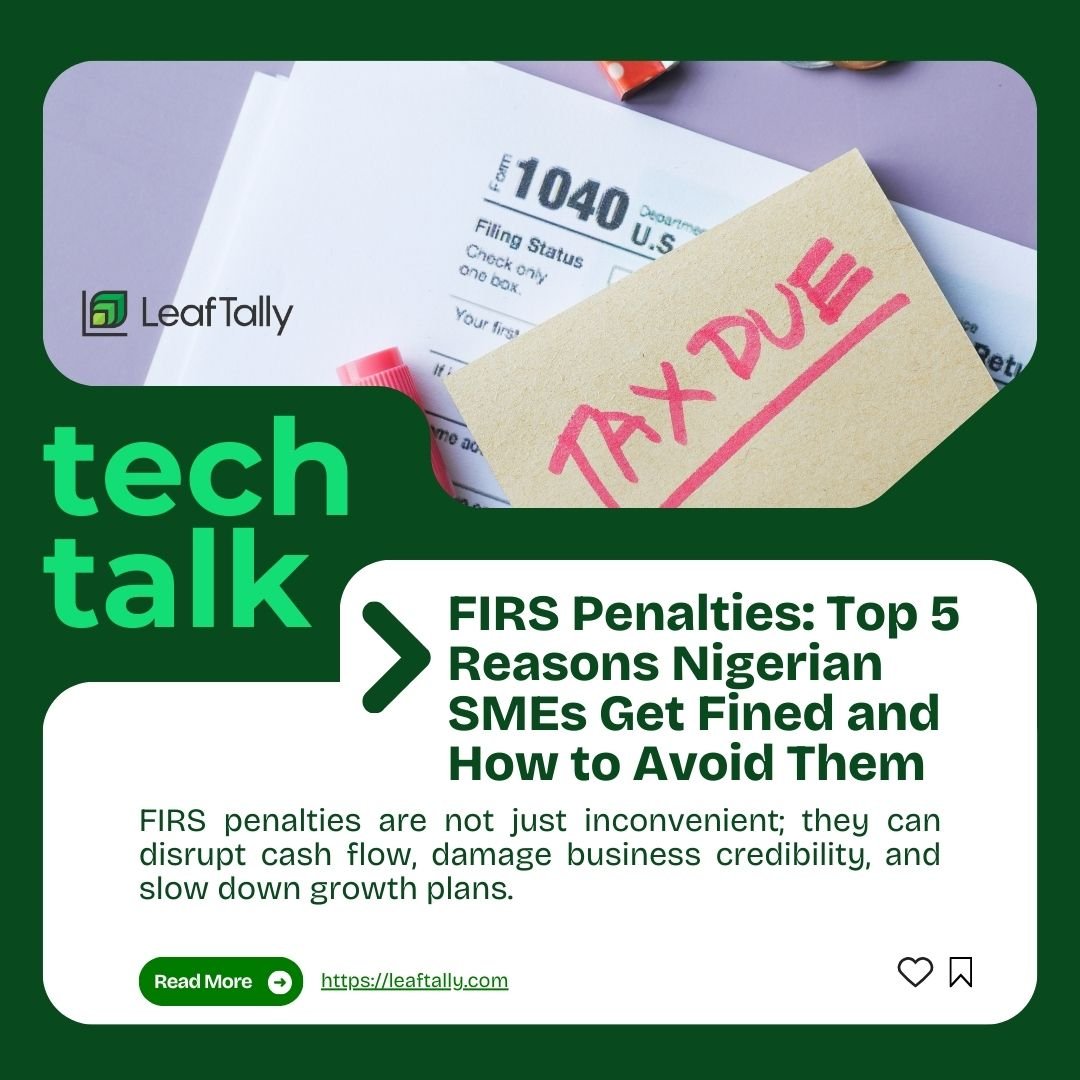
FIRS penalties are not just inconvenient; they can disrupt cash flow, damage business credibility, and slow down growth plans. For small and medium-sized businesses operating on tight margins, even a single penalty can feel overwhelming. That’s why understanding how to avoid FIRS penalties is not optional, it is a survival skill.
This article breaks down the top five reasons Nigerian SMEs get fined by FIRS, explains how these penalties happen in real life, and shows practical steps you can take to to avoid FIRS penalties. More importantly, it shows how smart financial softwares like Leaftally can act as a compliance safeguard for your business.
Understanding FIRS and Why Compliance Matters
The Federal Inland Revenue Service (FIRS) is responsible for assessing, collecting, and accounting for taxes owed to the Federal Government of Nigeria. These include:
- Companies Income Tax (CIT)
- Value Added Tax (VAT)
- Withholding Tax (WHT)
- Education Tax
- Stamp Duties (for certain businesses)
FIRS operates on the principle that every registered business must comply, whether profitable or not. Failure to comply often results in penalties, interest charges, audits, or enforcement actions.
Knowing how to avoid FIRS penalties starts with understanding where most SMEs go wrong.
Reason 1: Late Filing of Tax Returns
One of the most common reasons Nigerian SMEs get fined is late filing.
How This Happens
Many business owners assume that if they didn’t make much profit or made no profit at all, they don’t need to file returns. This is incorrect. FIRS requires annual tax returns regardless of business performance.
When deadlines are missed, penalties begin to accumulate automatically.
Common Filing Deadlines
- Companies Income Tax: Within 6 months after the accounting year-end
- VAT: On or before the 21st of the following month
- Withholding Tax: On or before the 21st of the following month
Penalties for Late Filing
- ₦25,000 for the first month of default
- ₦5,000 for every subsequent month
These amounts may seem small at first, but they add up quickly.
How to Avoid FIRS Penalties
To truly understand how to avoid FIRS penalties, businesses must:
- Track filing deadlines consistently
- Prepare financial records early
- Avoid last-minute submissions
Using a financial management tool like Leaftally helps ensure your records are always ready when filing season comes.
Reason 2: Inaccurate or Incomplete Financial Records
Poor record-keeping is one of the biggest compliance risks for SMEs.
How This Happens
Many businesses rely on:
- Memory instead of documentation
- Informal notebooks
- Unreconciled bank statements
- Missing receipts and invoices
When FIRS requests records during an audit, inconsistencies quickly surface.
Why FIRS Penalizes This
Inaccurate records make it difficult to verify tax liabilities. FIRS may:
- Reject submitted returns
- Estimate tax liabilities (often higher than reality)
- Apply penalties for false or misleading information
How to Avoid FIRS Penalties
If you want to master how to avoid FIRS penalties, accurate record-keeping is non-negotiable:
- Record income and expenses daily
- Reconcile bank statements regularly
- Keep proper documentation for all transactions
Leaftally simplifies this by helping businesses maintain clean, organized financial records that align with FIRS expectations.
Reason 3: Failure to Remit VAT and Withholding Tax
VAT and WHT are not your business’s money. They are taxes collected on behalf of the government.
How This Happens
Some SMEs:
- Collect VAT but delay remittance
- Forget to remit WHT deductions
- Mix tax funds with operational cash
This often leads to unintentional misuse of tax funds.
Penalties Involved
- 10% penalty on unremitted tax
- Interest at prevailing CBN rates
- Possible enforcement actions
FIRS treats these cases very seriously.
How to Avoid FIRS Penalties
Understanding how to avoid FIRS penalties here requires discipline:
- Separate tax collections from operating funds
- Track VAT and WHT monthly
- Remit on or before deadlines
With automated tracking and clear categorization, Leaftally helps ensure VAT and WHT obligations don’t get overlooked.
Reason 4: Ignoring Tax Notices and FIRS Correspondence
Another costly mistake SMEs make is ignoring emails, letters, or notices from FIRS.
How This Happens
Business owners may:
- Assume the notice is not urgent
- Delay responding due to fear or confusion
- Miss official communications entirely
Unfortunately, silence is interpreted as non-compliance.
What FIRS Does Next
When notices are ignored, FIRS may:
- Apply default penalties
- Conduct audits
- Freeze bank accounts in extreme cases
How to Avoid FIRS Penalties
To understand how to avoid FIRS penalties, businesses must:
- Take all FIRS correspondence seriously
- Respond promptly
- Keep compliance records easily accessible
Having centralized financial data through Leaftally makes responding to FIRS inquiries faster and less stressful.
Reason 5: Poor Bank Statement Reconciliation
Unreconciled bank statements are a hidden compliance risk.
How This Happens
Businesses often:
- Record sales but forget bank charges
- Miss failed or reversed transactions
- Have discrepancies between bank statements and books
During an audit, these mismatches raise red flags.
Why It Leads to Penalties
FIRS expects consistency between:
- Bank statements
- Financial records
- Tax filings
Any mismatch may be treated as under-reporting or misrepresentation.
How to Avoid FIRS Penalties
A key part of learning how to avoid FIRS penalties is regular reconciliation:
- Reconcile bank statements monthly
- Identify discrepancies early
- Adjust records correctly
Leaftally reduces reconciliation stress by keeping transactions organized and traceable.
The Cost of Non-Compliance Goes Beyond Fines
FIRS penalties don’t just affect your finances. They can also:
- Damage your business reputation
- Delay access to loans or investment
- Reduce trust with partners and regulators
Compliance is not just about avoiding punishment, it’s about building a credible, scalable business.
How Leaftally Helps You Stay Compliant
Leaftally is designed to help Nigerian businesses stay ahead of compliance risks.
With Leaftally, you can:
- Maintain accurate financial records
- Track income, expenses, and tax-related transactions
- Prepare for audits confidently
- Reduce the risk of errors that lead to penalties
Instead of scrambling to figure out how to avoid FIRS penalties after a problem arises, Leaftally helps you prevent those problems in the first place and as the saying goes, “prevention is better than cure”
Compliance Is a Business Advantage
FIRS penalties are avoidable. Most fines faced by Nigerian SMEs come from preventable mistakes like missed deadlines, poor records, or lack of visibility into financial data. When you understand how to avoid FIRS penalties, compliance becomes less about fear and more about control.
A compliant business is a trustworthy business. It attracts investors, builds credibility, and grows sustainably.
Take Control Before FIRS Comes Knocking
If you’re tired of uncertainty, last-minute tax stress, and the fear of unexpected penalties, it’s time to upgrade how you manage your finances.
Visit https://leaftally.com/ today and see how Leaftally helps Nigerian businesses stay compliant, organized, and confident so you can focus on growth, not fines.