When Business Growth Starts to Feel Chaotic
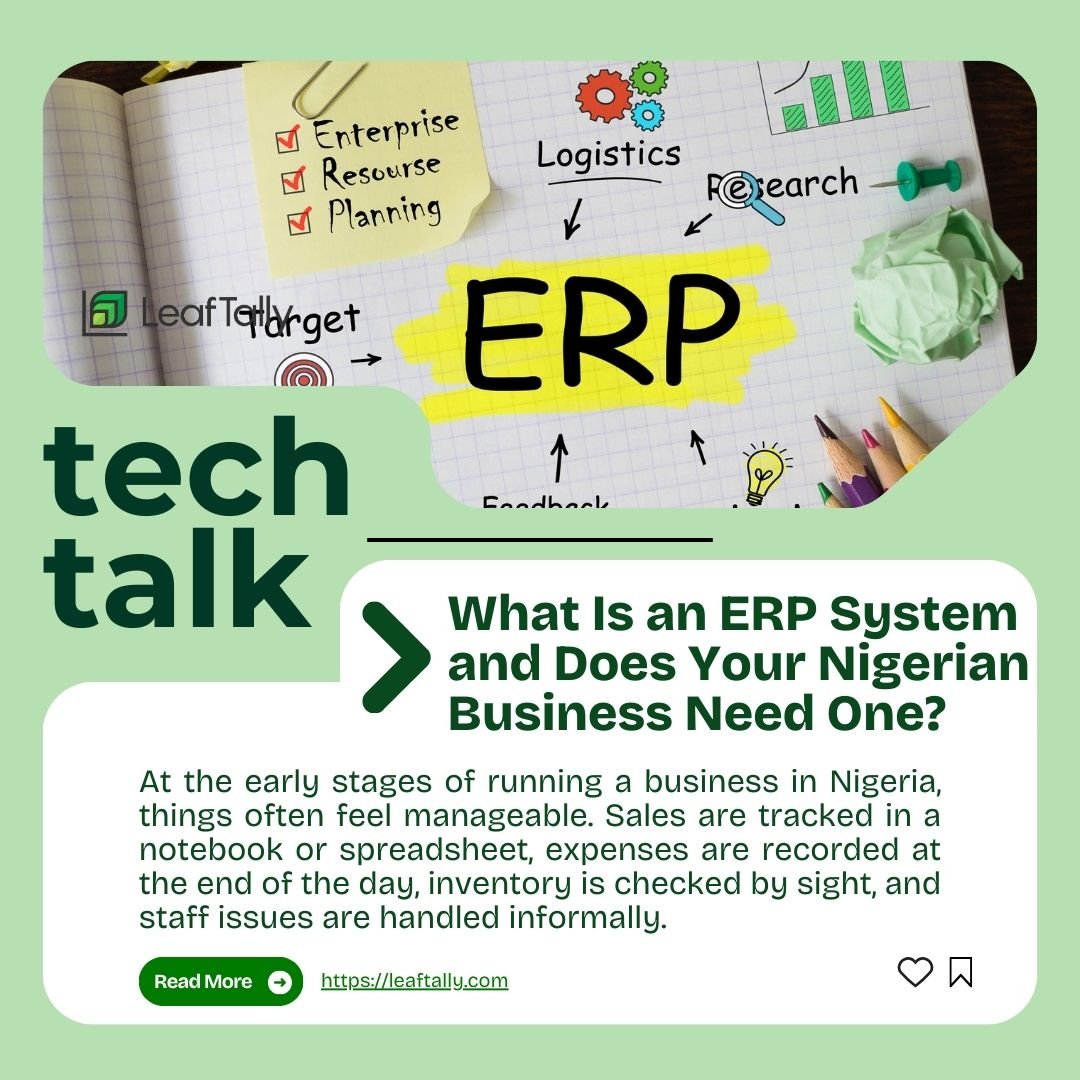
At the early stages of running a business in Nigeria, things often feel manageable. Sales are tracked in a notebook or spreadsheet, expenses are recorded at the end of the day, inventory is checked by sight, and staff issues are handled informally. But as the business grows, that simplicity starts to disappear, that is when an ERP system for small business should be considered.
Suddenly, information is scattered across different tools. Sales figures don’t match bank balances. Inventory numbers conflict with reality. Financial reports take days to prepare if they exist at all. At this point, many business owners hear a new term for the first time: ERP system.
It sounds complex. Expensive. Like something meant for large corporations, not small or growing Nigerian businesses. This leads to an important question: what is an ERP system, and does your business actually need one?
This article explains what an ERP system really is, how it works, and whether an ERP system for small business Nigeria makes sense for your stage of growth. More importantly, it shows how Nigerian businesses can benefit from ERP-like structure without unnecessary complexity, and how Leaftally serves as a simple entry point.
What Is an ERP System?
ERP stands for Enterprise Resource Planning. At its core, an ERP system is software that helps businesses manage and integrate their key operations in one place.
Instead of running separate tools for accounting, inventory, payroll, sales, and reporting, an ERP system brings everything together into a single, connected system.
An ERP system typically covers:
- Finance and accounting
- Inventory and stock management
- Sales and invoicing
- Procurement
- Human resources and payroll
- Reporting and analytics
The goal is simple: one source of truth for your business data.
Why ERP Systems Exist in the First Place
ERP systems were created to solve a common problem: fragmentation.
When different departments or functions use different systems, data becomes inconsistent. Decisions are made based on incomplete or outdated information. ERP systems eliminate this by centralizing data and processes.
For Nigerian businesses, fragmentation often looks like:
- One spreadsheet for sales
- Another for expenses
- Bank statements reviewed separately
- Inventory tracked manually
- Payroll calculated independently
An ERP system for small business Nigeria aims to reduce this chaos by creating structure and visibility.
The Common Misconception About ERP Systems
Many business owners believe ERP systems are:
- Only for large corporations
- Too expensive
- Too complex to use
- Overkill for small teams
While this was true in the past, it’s no longer entirely accurate. Modern ERP solutions now come in different levels, some specifically designed for small and medium-sized businesses.
The real issue is not whether ERP systems are useful, but whether the right type of ERP system fits your business.
What an ERP System Looks Like in Practice
To understand whether you need an ERP system for small business Nigeria, it helps to see how it works in daily operations.
With an ERP system:
- A sale automatically updates revenue, inventory, and reports
- Expenses reflect instantly in financial records
- Inventory levels update in real time
- Reports are generated without manual compilation
Everything is connected. This reduces errors, saves time, and improves decision-making.
Signs Your Nigerian Business May Need an ERP System
Not every business needs a full ERP immediately. However, certain signs indicate it’s time to consider one.
1. You Spend Too Much Time Reconciling Information: If you regularly struggle to match sales records with bank statements or inventory counts, fragmentation is already costing you time.
2. Your Business Data Lives in Too Many Places: Spreadsheets, notebooks, WhatsApp messages, bank apps; when information is scattered, control is lost.
3. You Lack Clear Financial Visibility: If you can’t confidently answer questions like:
- How much profit did we make last month?
- Which products are actually profitable?
- Where is cash being tied
4. Growth Feels Disorganized: Hiring staff, increasing stock, or expanding locations becomes stressful instead of exciting. These are strong indicators that an ERP system for small business Nigeria could add value.
The Nigerian Context: Why ERP Feels Intimidating
ERP adoption in Nigeria comes with unique challenges:
- Budget constraints
- Limited technical support
- Fear of complex systems
- Lack of accounting background
Many traditional ERP systems were not built with Nigerian SMEs in mind. They often require consultants, long onboarding periods, and heavy customization.
This is why many small businesses delay adopting any structured system at all—until inefficiencies become costly.
Do All Small Businesses Need a Full ERP System?
The honest answer: no.
Very small or early-stage businesses may not need a full enterprise-grade ERP. What they do need is:
- Centralized financial data
- Clear visibility
- Scalable systems
This is where lightweight, modular solutions come in.
How Leaftally Fits Into the ERP Conversation
Leaftally is not positioned as a heavy, traditional ERP. Instead, it provides the foundation many Nigerian businesses need before full ERP complexity.
Leaftally helps businesses:
- Centralize financial data
- Track income and expenses clearly
- Improve cash flow visibility
- Prepare for compliance and audits
- Build structured records that scale
For many SMEs, Leaftally acts as a practical entry point into ERP-style organization without the cost or complexity of traditional systems.
ERP Benefits Nigerian Businesses Care About
When implemented correctly, an ERP system for small business Nigeria delivers real benefits:
- Better decision-making
- Reduced manual errors
- Improved operational efficiency
- Stronger financial control
- Easier compliance
The key is choosing a system that aligns with your size and needs.
Conclusion: Start Simple, Build Smart
ERP systems are no longer reserved for large corporations. For Nigerian businesses, the real challenge is not whether to adopt structure, but how to do it without overwhelming the team or budget.
An ERP system for small business Nigeria should simplify operations, not complicate them. It should give you clarity, control, and confidence not confusion.
Take the First Step Toward Structured Growth: You don’t need to jump straight into a complex ERP to benefit from better organization. Starting with the right financial foundation makes all the difference.
Visit https://leaftally.com/ today to see how Leaftally helps Nigerian businesses centralize financial data, gain clarity, and build ERP-ready systems one smart step at a time.
Structure is not about size. It’s about readiness.